NSF-Funded Cyberinfrastructure
Distributed Shared
Tiered Log Store
Activity data describe things that happen rather than things that are.
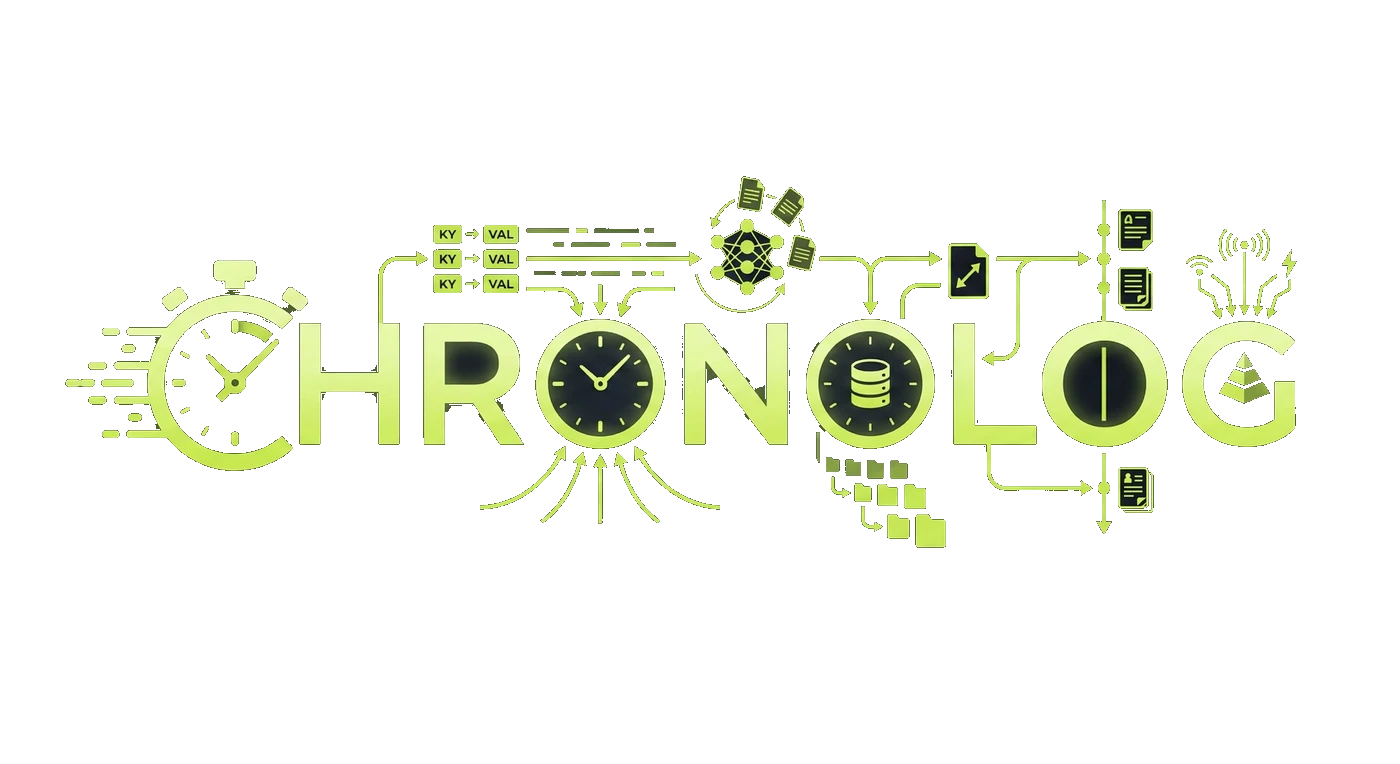
ChronoLog is a distributed log storage ecosystem that uses physical time as the ordering mechanism - eliminating centralized sequencers and enabling auto-tiered storage across multiple layers. Built to capture the velocity and variety of modern activity data: from scientific instruments producing terabytes per second to AI agent audit trails.
Collaborators & Partners








What Makes ChronoLog Different
Traditional distributed logs rely on centralized sequencers and consensus protocols to order events. ChronoLog takes a fundamentally different approach.
Physical Time Ordering
Uses synchronized physical clocks instead of Paxos/Raft consensus to order events. No centralized sequencer bottleneck.
Lock-Free Concurrent Writes
Multiple distributed writers append simultaneously without coordination. I/O paths are fully isolated between processes.
Auto-Tiered Storage
Data moves automatically across hot, warm, and cold storage tiers. Elastic capacity without manual data management.
Immediate Visibility
Events are visible to readers as soon as they are written. Total ordering with concurrent access at scale.
How It Works
ChronoLog separates ingestion, ordering, persistence, and replay into five specialized services that form a tiered pipeline.
Coordination & clock synchronization
Fast ingestion via RDMA (hot tier)
Event assembly & story building (warm tier)
Persistent archival in HDF5 (cold tier)
Cross-tier reads & replay
An Extensible Platform
ChronoLog is designed as a foundation that other systems build upon. Its plugin architecture supports query, streaming, storage, and AI integration workloads.
SQL Query
Familiar SQL semantics over time-ordered log data.
Pub/Sub & Streaming
Real-time event streaming via ChronoGrapher's DAG pipeline.
Key-Value Store
Time-series KV semantics with built-in ordering guarantees.
ML & Training
TensorFlow integration for time-ordered data pipelines.
AI Agent Memory
MCP server for persistent agent memory and audit trails.
Project at a Glance
ChronoLog is a multi-year research effort backed by the National Science Foundation and developed in partnership with DOE national laboratories and universities.
NSF CSSI grant funding
Peer-reviewed publications at top-tier venues (SC, MSST, CLUSTER, IPDPS, ICS)
Years of active development since 2020
Partner institutions including DOE national labs, universities, and industry
Deployed at national laboratory partner sites and university clusters
Taught in the Classroom
Used as teaching infrastructure in distributed systems and HPC graduate courses at IIT. Students learn real-world distributed log design using ChronoLog's APIs and deployment tools.
Cross-Disciplinary Research
Beyond HPC, ChronoLog has been applied in nutrition analysis (with IIT's Department of Food Science) and genomic sequencing pipelines, demonstrating its versatility across domains.
Deployed on Clusters
Active installations on the GRC research cluster and available at DOE partner sites. Used for continuous research workloads including HPC system monitoring and provenance tracking.
Get Involved
ChronoLog is open source and welcoming collaborators. Whether you're a researcher exploring distributed log abstractions, a developer building on the plugin ecosystem, or an institution looking for scalable logging infrastructure -- we'd like to hear from you.
Supported by a $4M National Science Foundation CSSI Grant
NSF CSSI-2104013